- Strategic partnerships help companies grow without building every capability internally.
- The right partner protects trust while turning opportunities into outcomes.
Why Software Companies Are Turning to Strategic Partnerships for Faster Growth
Published on: 6 July 2026
Last updated on: 9 July 2026
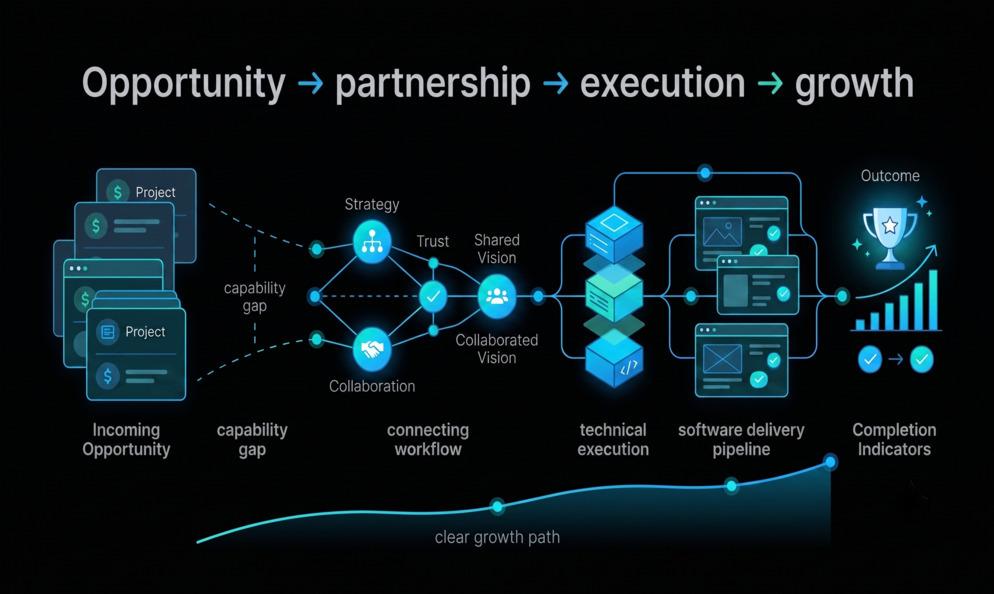
Software companies are not struggling because growth opportunities disappeared.
Many are struggling because the opportunities are bigger than what they can deliver alone.
A client needs development, but the agency does not have engineers.
A founder needs technical execution, but the advisor only supports strategy.
A fractional CTO has multiple clients, but not enough delivery capacity behind them.
Most companies do not realize they need a partner when things are slow.
They realize it when the right opportunity appears and they are not fully ready to deliver it.
Ads can create attention.
Outbound can start conversations.
Hiring can add capacity.
But if ads are expensive, outbound is crowded, hiring is slow, and referrals are unpredictable,
How do software companies keep growing without carrying every burden alone or building an engineering team for every new demand?
That is why more software companies, agencies, consultants, CTOs, and startup advisors are turning to strategic partnerships as a smarter growth channel.
The right partnership does more than send leads back and forth.
It combines trust, technical capability, delivery support, and shared client outcomes.
In this article, I’ll break down:
- Why partnerships are becoming a serious growth channel, not just a referral tactic
- How they help companies grow without carrying every capability internally
- What makes a software partnership actually work
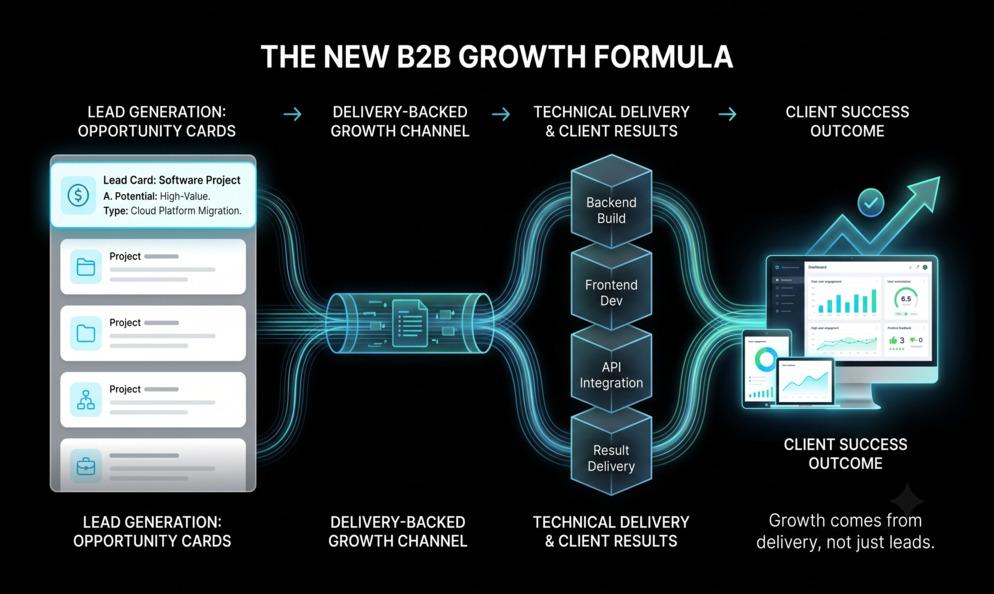
Growth Is No Longer Just About Getting More Leads
Growth used to look simpler.
Get more traffic.
Book more calls.
Hire when demand increases.
Ask happy clients for referrals.
That still works.
But it is no longer enough.
Because software buyers are not only asking, Can you build this?
They are asking, Can you understand the problem, reduce the risk, and deliver it properly?
That changes the growth equation
Attention alone is not growth.
A conversation alone is not growth.
A referral alone is not growth.
Even hiring alone is not growth.
An agency can win the client’s trust and still lose the project if the client asks for a SaaS platform, AI workflow, or custom integration the agency cannot deliver internally.
Growth happens when the right opportunity meets the right capability at the right time.
For many software companies, agencies, consultants, and advisors, that is where growth starts to slow down.
Not because the opportunity is missing, but because the right delivery capability is not in place yet.
The Real Growth Gap Is Capability
In my career, I have seen many companies lose growth not because they lacked ambition, but because the opportunity required more capability than they had at that moment.
A marketing agency may already have the client’s trust, but lose the project when the client asks for custom software.
A startup advisor may know exactly what a founder should build, but still need a reliable technical team to turn that advice into a working product.
A fractional CTO may guide product direction, but need dependable execution support across multiple clients.
This is where growth becomes difficult.
Not because the opportunity is weak.
But because the company has to choose between three risky options:
- Say no and lose the opportunity
- Say yes and stretch the team too far
- Hire quickly before demand is stable
None of these are ideal.
This is the capability gap.
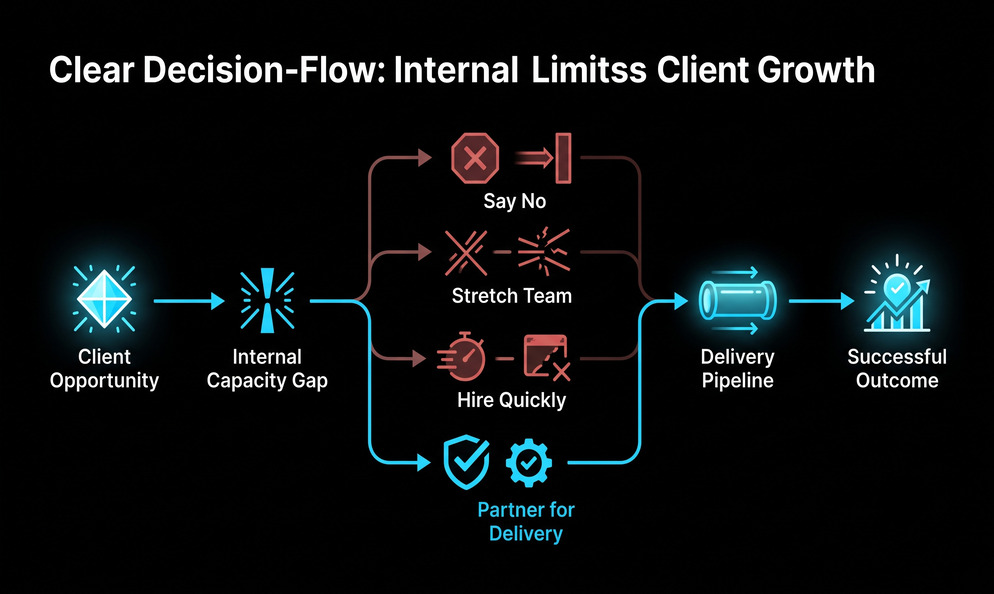
Strategic partnerships are becoming important because they help companies close that gap without pretending they can do everything alone.
Strategic Partnerships Are Becoming a Real Growth Channel
This capability gap is one reason strategic partnerships are moving to growth strategy.
For years, many companies treated partnerships as informal referrals.
Someone knew someone.
A client made an introduction.
A project came through a friendly connection.
That still happens.
But the market is changing.
Forrester’s research on B2B partner ecosystems shows that partner ecosystems are becoming an increasingly important part of how B2B organizations create growth and customer value.
In software, this shift is even clearer.
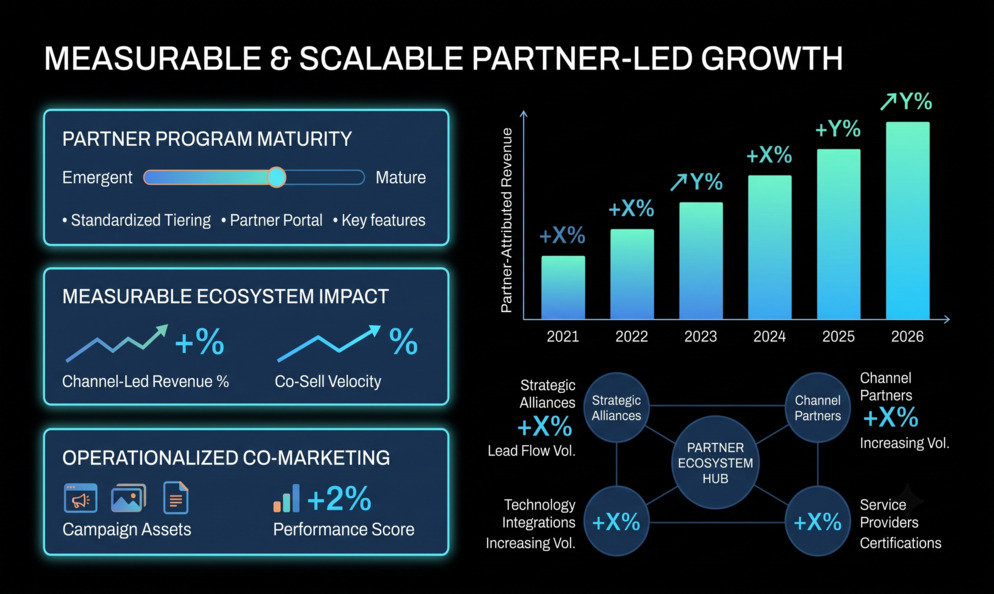
PartnerStack’s report on partner-driven software sales reports that software sales through its partner network have reached new highs for 7 consecutive years, with more than $1.9B in software sales generated through the network to date.

Source: PartnerStack
That tells us something important.
Partnerships are no longer only about relationships.
They are becoming structured growth channels.
The reason is simple:
- Partners already have trust
- Partners understand their audience
- Partners can create warmer opportunities
- Delivery teams can help turn those opportunities into outcomes
This is why strategic partnerships matter.
They do not replace marketing, sales, or referrals.
They make growth less dependent on one channel and more connected to the relationships, expertise, and capabilities a company already has.
What Strategic Partnerships Actually Mean in Software
A strategic partnership is not just two companies sending leads to each other.
In software, it works best when each side brings a different strength to the same client problem.
One side may already have the trust.
They understand the client, the business context, the market, or the founder’s vision.
The other side brings the technical team, delivery process, and execution capacity.
That is where the partnership becomes valuable.
Because most clients do not only need advice.
They need the advice to become a working product, platform, workflow, or system.
For example:
- A digital agency may need an agency partnership when clients ask for software development beyond its internal team.
- A startup advisor may need a startup advisor and consultant partnership to help non-technical founders move from strategy to execution.
- A fractional CTO may need a fractional CTO partnership to support delivery across multiple clients without building a full internal team.
- A consultant or network-based professional may use a referral partner program to connect the right opportunity with a team that can deliver it properly.
That is what makes the partnership strategic.
It is not based on random introductions.
It is based on shared value, clear roles, and better client outcomes.
Why Partnerships Grow Faster Than Traditional Channels
Strategic partnerships grow differently because they do not start from zero.
A cold ad starts with attention.
A cold email starts with interruption.
A random website visit starts with curiosity.
But a partnership often starts with trust.
That changes everything.
Modern B2B growth is no longer built around one channel.
McKinsey’s B2B Pulse research shows that decision-makers want to interact across many channels.
This is one reason partnerships matter.
A strong partner relationship creates a more personal path into the buyer’s world.
When a client already trusts an agency, advisor, CTO, consultant, or referral partner, the conversation moves faster.
The buyer does not need to evaluate everything from the beginning.
They already have a trusted person guiding the decision.
That is why partnerships can create stronger growth than isolated channels.
Why Strategic Partnerships Work Differently?
|
Growth Channel |
What It Helps With |
What It Often Lacks |
|
Paid ads |
Visibility and traffic |
Trust and delivery confidence |
|
Outbound |
Starting conversations |
Warm context and buyer readiness |
|
Hiring |
More internal capacity |
Speed and flexibility |
|
Referrals |
Trust-based introductions |
Predictability and structure |
|
Strategic partnerships |
Trust, access, capability, and delivery support |
Clear roles and process |
This is the difference between a referral and a real partnership.
A referral opens the door.
A strategic partnership helps make sure the opportunity can actually be delivered well.
Software Partnerships Need More Than Good Intentions
Growth through collaboration sounds attractive.
But in software, good intentions are not enough.
A weak delivery relationship can create more problems than it solves.
A poor handoff can confuse the client.
An unclear scope can damage the timeline.
A wrong estimate can create budget pressure.
A delivery mistake can hurt a relationship that took years to build.
For agencies, advisors, and consultants, the risk is not only project failure. It is reputation damage.
That is why the right delivery partner should make the client relationship safer, not more complicated.
Not just enthusiasm.
Not just trust.
Not just “we know a good team.”
It needs clear roles, technical validation, honest communication, and delivery accountability.
Before any serious project moves forward, both sides should understand:
- Who owns the client relationship
- Who owns technical discovery
- How scope and estimates are validated
- How updates will be communicated
- How risks will be handled before they become surprises
This is what separates a real growth relationship from casual outsourcing.
The goal is not only to win more opportunities.
The goal is to protect the trust behind those opportunities while delivering the work properly.
What Makes a Software Partnership Actually Work
A good software partnership does not depend on hope.
It depends on structure.
Before any serious collaboration starts, both sides should know how the relationship will work.
The strongest partnerships usually have a few things in common:
|
What matters |
Why it matters |
|
Clear roles |
Everyone knows who owns the client relationship, discovery, delivery, and communication. |
|
Technical validation |
Scope and estimates are checked before promises are made. |
|
Transparent communication |
Updates, blockers, and risks are shared early. |
|
Delivery accountability |
The technical team owns outcomes, not just task completion. |
|
Shared expectations |
Timeline, budget, quality, and responsibilities are aligned from the beginning. |
|
Long-term mindset |
The relationship is built for repeat collaboration, not one-off project handoff. |
Without this structure, collaboration becomes fragile.
With it, the partnership becomes easier to trust, easier to scale, and safer for the client.
How a Strategic Software Partnership Actually Works
A strong partnership needs more than agreement.
It needs a clear operating flow.
Without that, even a good opportunity can become confusing for the client, the partner, and the delivery team.
In most software partnerships, the process should look simple:
|
Step |
What Happens |
|
Opportunity is identified |
The partner brings a client need, referral, or software opportunity. |
|
Technical discovery begins |
The delivery team reviews goals, scope, risks, and technical requirements. |
|
Proposal is prepared |
Both sides align on timeline, budget, responsibilities, and delivery model. |
|
Project delivery starts |
The technical team handles execution with clear communication and accountability. |
|
Partner value is created |
The partner can expand service value, referral revenue, or client retention. |
|
Long-term support continues |
The relationship can continue through updates, improvements, support, or future projects. |
This is where the partnership becomes easier to trust.
Everyone knows what happens next.
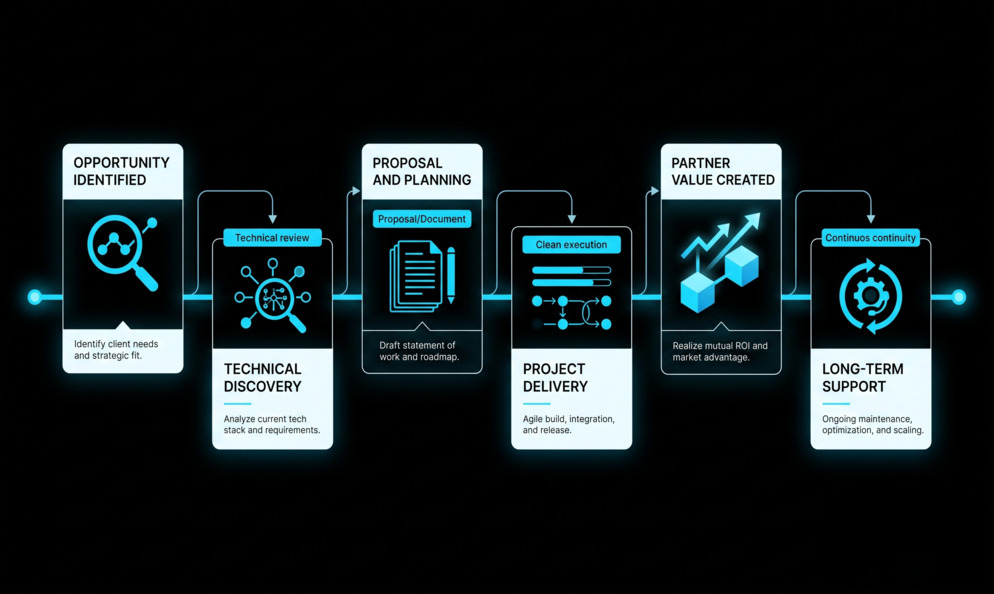
The partner does not have to guess how the technical side will be handled.
The client gets a clearer delivery path.
And the opportunity has a better chance of becoming a real software outcome.
A Simple Partnership Scenario
A client may trust your agency, advisory, or consulting support.
Then the client asks for something more technical:
- a SaaS MVP
- a custom platform
- a system integration
- an AI-enabled feature
At that point, you have a choice:
- say no
- hire too early
- stretch your team
- or bring in the right technical delivery partner
That is where the model becomes practical.
You keep the relationship.
The delivery partner supports discovery, development, QA, and launch.
The client gets a real software outcome.
I have seen this kind of execution across Mediusware projects.
For example, Linktiva needed an AI-powered SEO automation product, and Mediusware helped build a scalable solution that reduced manual work and improved workflow efficiency.
In another project, Conquest Air Cargo needed a stronger digital platform, and the result helped drive measurable business growth.
The details may differ.
But the pattern stays the same:
When the right technical team stands behind the opportunity, the client gets more than advice; they get results.
Where Mediusware Fits Into This Partnership Model
At Mediusware, I see partnerships as a way to help people create more value for the clients they already serve.
Some partners bring the relationship.
Some bring strategy.
Some bring founder trust.
Some bring market access or referral opportunities.
Mediusware brings structured software execution and long-term technical support.
That can include AI development, web and mobile app development, QA, DevOps, and long-term technical support.
The goal is not to replace the partner’s role. The goal is not to take over the client relationship.
The goal is to support the delivery behind it. The goal is to strengthen it.
When the right opportunity appears, partners should not have to choose between saying no, hiring too early, or stretching beyond their capability.
With the right delivery structure, they can support larger opportunities without turning every new request into a hiring risk or margin problem.
A structured partnership gives them another option:
Work with a technical team that can help turn the opportunity into a real software outcome.
That is the foundation of Mediusware’s Partnership Program.
Who This Is Really For
This is a strong fit if:
- Clients trust you, but need software execution beyond your team
- You want to say yes to larger technical projects without hiring a full in-house team first
- You advise founders, but need a technical team behind the strategy
- You manage client relationships, but do not want to carry delivery alone
- You see software opportunities through your network
- You want to offer more value without building every capability internally
If you are close to the opportunity but need the right team to execute it, this kind of partnership makes sense.
Final Thoughts
Growth is becoming more collaborative because software opportunities now require more trust, more capability, and better execution than one team can always carry alone.
The companies that grow smarter will not try to build every capability internally.
They will know when to combine relationship, strategy, and technical execution through the right partnership.
Frequently Asked Questions
A strategic partnership in software is a working relationship where one side brings client trust, strategy, or market access, while the other side brings technical execution, delivery process, and software development capability.

I work with founders and leadership teams when growth moves faster than their systems, teams, or decisions. I’ve led 850+ projects for 750+ clients across 20+ countries, working across 100+ technologies and counting. I care about ownership, clarity, and building things that last beyond the launch.