- Launch an MVP that solves one clear problem for early adopters.
- Turn feedback, simple payments, and trust signals into paying users.
How to Launch Your First Paying Users with Just an MVP
Published on: 7 May 2026
Last updated on: 10 June 2026
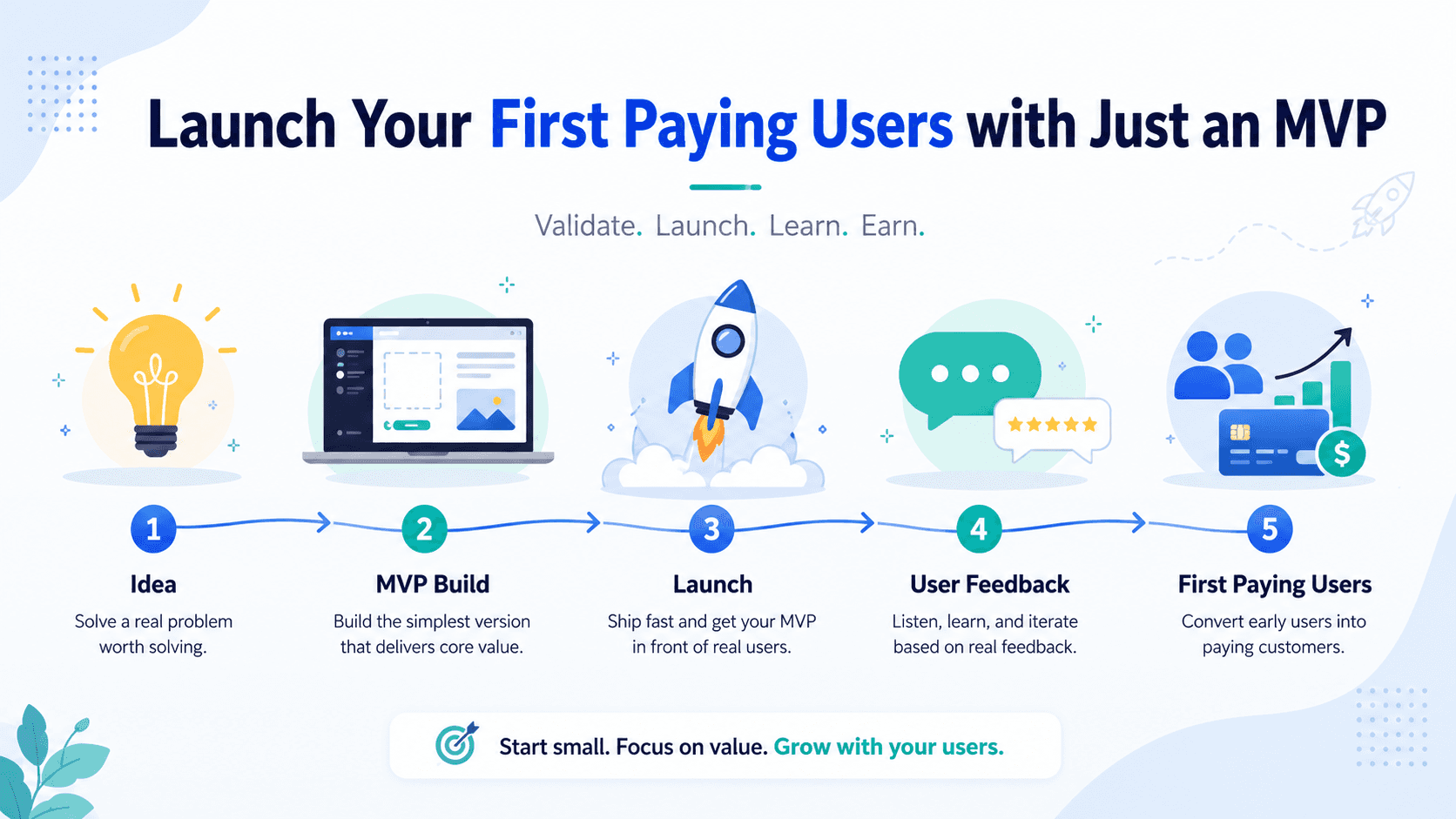
Launching an MVP (Minimum Viable Product) is one of the most crucial steps in building a successful startup.
It’s about testing the core value of your idea with real users before investing too much time and resources.
But how do you launch an MVP and actually get your first paying users?
Let’s break it down into a simple process.
Focus on the Core Value of Your MVP
Keep it simple and lean.
An MVP is designed to test the core functionality of your product. When launching, you don’t need a fully-featured product; you need the essential features that demonstrate the unique value your product offers.
Tip to follow: Don’t overbuild. Instead, identify your MVP's "must-have" features and focus on delivering those. This is not the time for adding extra features that may distract you from your main objective, learning from your users.
Learn more about MVP feature prioritization here.
Why Core Features Matter
| Feature | MVP Stage | Post-MVP Stage |
| Core Functionality | Prioritize only the most valuable features | Add features based on feedback and usage |
| User Interface | Simple and intuitive | Enhanced with more complex workflows |
| Marketing | Focus on early adopters | Expand to broader marketing channels |
Identify Your Ideal Customer
Know who you're building for.
Before you launch, identify your target audience. For your MVP to succeed, it’s crucial to know who your ideal paying users are. Focus on early adopters who are willing to give feedback and help you iterate.
These users might be the first to understand the value of your product and willing to pay to use it early on.
Tip to follow: Use your network, conduct surveys, and gather insights on who faces the problem your product is solving.
Discover more on customer persona development here.
Gather Early Feedback and Iterate Quickly
Launch, listen, and learn.
Once your MVP is live, gather feedback from your first users. This feedback loop is essential to iterate quickly and refine your product. The faster you can adapt to your users' needs, the better your chances of attracting more paying customers.
- Surveys & Interviews: Ask users about their experience and pain points.
- User Testing: Watch how users interact with the product to identify areas for improvement.
- Analytics: Use tools to track behavior and identify what features get used most and least.
Make Payment Easy for Your Users
Remove friction from the buying process.
Your MVP should not only solve a problem, it should be easy for users to pay for it. Consider simple pricing models like subscription-based or one-time payments. Make sure that the checkout process is straightforward and doesn’t hinder potential paying users from completing their purchase.
Tip to follow: Offer early adopters a discount or extra features to encourage them to become your first paying users.
Check out these payment integration tools for your MVP.
Leverage Case Studies to Build Trust
Share real success stories.
Case studies are a great way to build credibility and trust with your audience. Sharing how your MVP helped solve a problem or improve a process for others can make it easier for new users to commit to paying for your product.
For example, Bulk.ly, a social media management platform we built, successfully launched its MVP by focusing on bulk scheduling and content automation. The result? A 90% reduction in manual scheduling effort, and it attracted paying users who needed a streamlined process.
According to Reid Hoffman, Co-founder of LinkedIn
With the right MVP, you don't have to build everything. Just focus on solving the core problem.
Watch more about the Mediusware Case Study.
Market Your MVP to the Right Audience
Get your first paying users in the door.
After building the MVP, you need to market it to attract users. Here are a few strategies:
- Leverage Social Proof: Use testimonials from your early users to show how your product has benefited them.
- Referral Programs: Reward users who refer others to sign up and try your MVP.
- Exclusive Offers: Provide early users with exclusive access or additional features if they sign up and become paying customers.
Explore marketing strategies for MVPs.
Simplify Your Product's Journey
It’s all about the user experience.
Even though we’re focused on an MVP, your product should still provide a smooth, intuitive experience. By focusing on the user’s journey, you ensure they can see the value and easily adopt your product.
According to Mark Zuckerberg, Founder of Facebook
A product is only successful when it fits a real need, and users see that clearly. Keep the focus on solving their problem, and the users will follow.
Read more about creating user-friendly MVPs.
Final Thoughts: Launch, Learn, and Grow
Launching your first paying users with an MVP isn’t just about getting users; it’s about creating value, gathering feedback, and improving your product based on real-world use.
Focus on solving the core problem, ensure your product is easy to pay for, and learn quickly from your first users.

I work with founders and leadership teams when growth moves faster than their systems, teams, or decisions. I’ve led 850+ projects for 750+ clients across 20+ countries, working across 100+ technologies and counting. I care about ownership, clarity, and building things that last beyond the launch.
Featureblogs
Relatedblogs
Authorblogs
01
How to Choose an API Development Company for Your SaaS Product02
Why Software Companies Are Turning to Strategic Partnerships for Faster Growth03
Your SaaS Isn’t Slow Because of Developers It’s a Scaling Problem04
Why Some SaaS Companies Scale Faster Than Others05
AI vs Hiring: When Should SaaS Teams Automate Instead of Hiring?