- Google rankings now depend on visibility across traditional and AI search.
- Brands need useful, authoritative content that drives measurable business outcomes.
Ranking on Google in 2026: What Really Matters in the Age of AI Overviews, AI Mode, and Changing SERPs
Published on: 28 August 2026
Last updated on: 28 August 2026
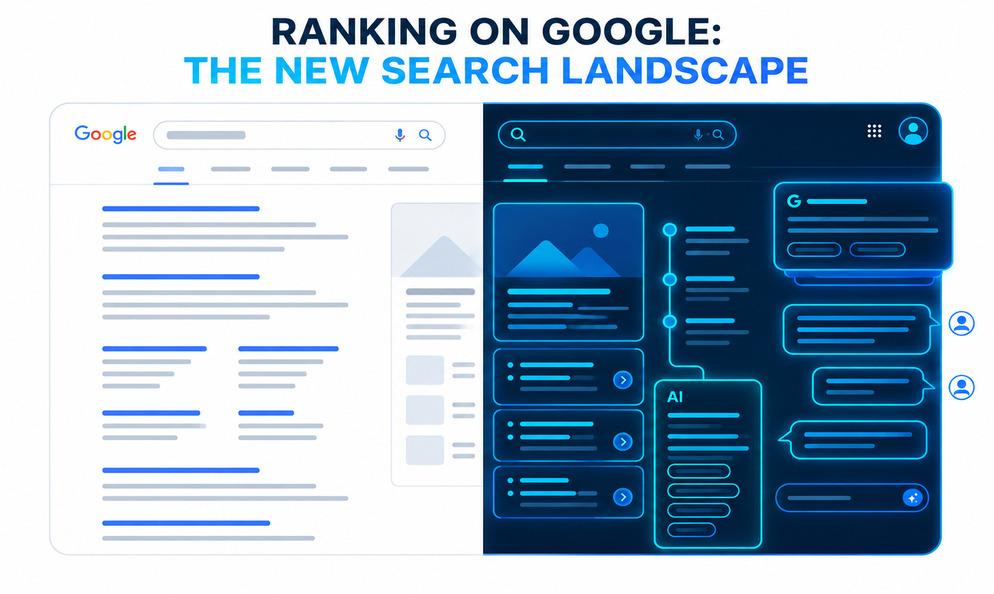
We all started with good intentions. You wrote the article. Did the keyword research. Built the links, fixed the metadata, and improved the page experience. Then you watched the rankings.
For years, that made sense. Move from position #8 to #3. Push from #3 to #1. More visibility meant more traffic.
That equation is getting harder to rely on. SparkToro's 2026 research with Similarweb found that 68% of U.S. Google searches ended without a click.
And ranking well does not guarantee that the searcher will ever reach your result. Google can now answer parts of a query through AI Overviews and AI Mode, while forums, videos, shopping results, People Also Ask, and other sources compete for space on the same SERP.
The basics of SEO still matter. Google still uses its core ranking and quality systems, and its guidance for AI search says the same SEO fundamentals continue to apply.
What changed is the search experience around those rankings. Being #1 still matters. But it no longer tells you the whole story about whether someone sees your brand, clicks your page, or finds your answer through an AI-generated result.
The game is not completely different. The board is just a lot bigger now.
What the Google SERP Looks Like in 2026
Most people still picture a list of blue links. That is not what shows up anymore. If you are still optimizing for a simple page of results, you are ignoring the majority of google serp features that now determine visibility.
The search results page in 2026 is a stacked interface. Google can now answer searches directly through AI Overviews and pull users into longer conversations through AI Mode. These features, announced at Google I/O 2026, now cover roughly half of all queries.
The traditional organic result is still there. It is just buried. This matters because most SEO tools still report position as if the page were a simple list. They are measuring a landscape that no longer exists.
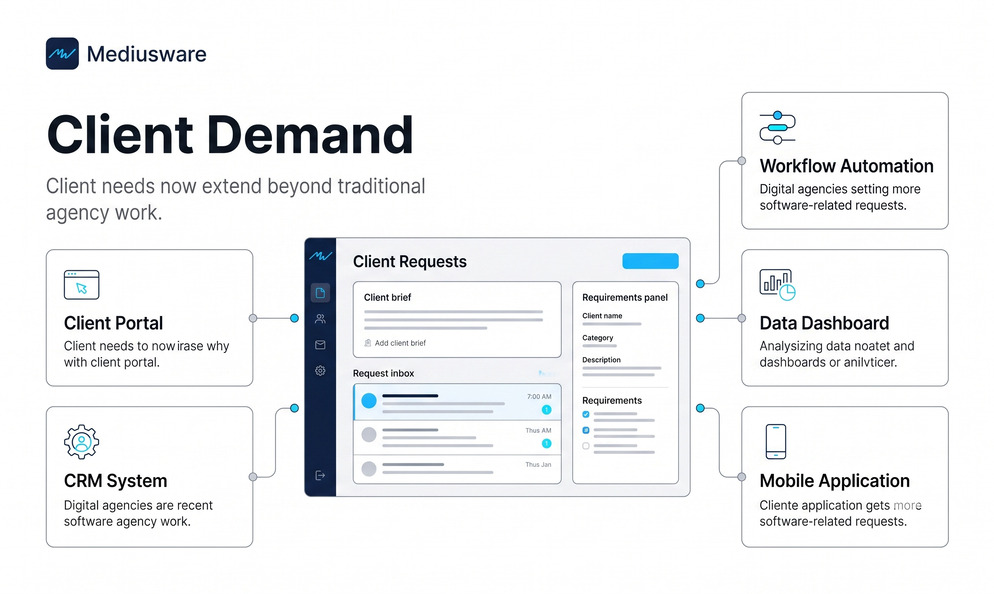 The Five Zones of the Modern SERP
Here is what actually appears when someone searches today:
- Zone 1: AI Overviews. A generated summary at the top, often citing three to five sources.
- Zone 2: AI Mode. A conversational layer that lets users ask follow-up questions without leaving Google.
- Zone 3: Video and Short-Form Content. YouTube videos, Shorts, and video carousels now surface for informational queries that used to return only text.
- Zone 4: People Also Ask and Forums. Predictive questions and Reddit-style discussions occupy prime real estate.
- Zone 5: Traditional Blue Links. The classic organic results. They still exist. They are just lower on the page.
Each zone competes for the same click. Your blog post might rank #1 in Zone 5. But if Zones 1 through 4 already answered the question, the user never scrolls down.
Why This Kills Traditional Rank Tracking
A rank tracker tells you that you hold position #3. It does not tell you that an AI Overview sits above you. It does not tell you that a video carousel pushed your link below the fold.
It does not tell you that the query triggered AI Mode. That feature alone can keep a user inside Google for 6 minutes.
The data is stark. Only 38% of pages cited in AI Overviews also rank in the top 10 organic results, down from 76% just eighteen months ago. The rest come from pages ranking 11th or lower or from sources that do not rank in the top 100 at all.
And here is the twist. Pages that rank for Google's fan-out queries are 161% more likely to be cited than those ranking only for the main query. Google breaks your query into sub-questions, then pulls sources from those secondary results. A page that never ranks for the head term can still dominate the citation.
The old metric was position. The new metric is presence.
Did you appear in the Overview?
Did your video show up in the carousel?
Did your brand get cited in the forum summary?
If the answer is no, you are ranking well and still losing.
Google AI Mode Is Not the Same as AI Overviews
Google AI Overviews and Google AI Mode are often grouped together. They should not be.
Both use generative AI inside Google Search, but they change the search journey in different ways. And that difference affects what an organic ranking is actually worth.
AI Overviews Summarize the SERP
A Google AI Overview appears within the regular search experience, giving users a generated summary with links to supporting sources. Traditional organic results still exist, but they now compete with an answer that may satisfy the search before the user scrolls.
That can have a real effect on clicks. A 2026 randomized field experiment Confirms Google AI Overviews Cut Organic Clicks 38%.
The exact impact will vary by query, but the direction is clear: ranking highly does not guarantee the same visibility or click opportunity it once did.
Google AI Mode Changes the Search Journey
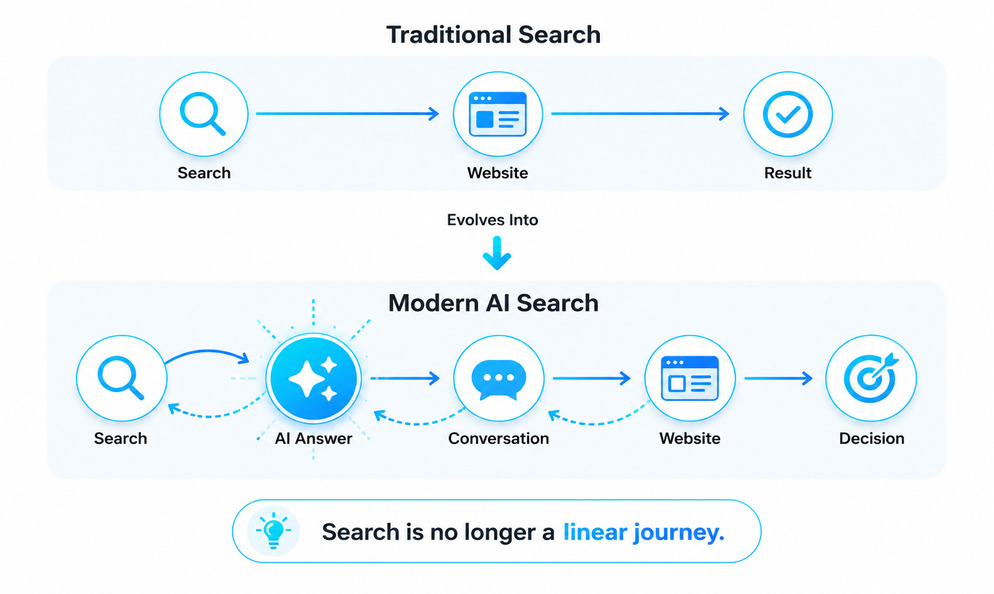 Google AI Mode goes further by turning search into a conversational experience. Users can ask a question, compare options, refine the request, and continue with follow-up questions instead of repeatedly returning to a traditional results page.
Google Search Central's AI features guidance explains that AI Mode and AI Overviews may use query fan-out, running multiple related searches across subtopics and data sources to build a response.
So the journey can shift from: Query → SERP → Website
to: Question → AI Response → Follow-up → Supporting Source → Website
The click has not disappeared. It may simply happen later, after Google has already helped shape the user's decision.
What This Means for SEO
Ranking alone is no longer the main issue, rather it is search visibility across the whole journey. Semrush's 2026 AI Overview study analyzed more than 600,000 keywords and found that the presence of AI Overviews on commercial-intent SERPs increased by 71% during its six-month study.
So a position #3 ranking tells only part of the story. You also need to know what appears above that result, whether your brand becomes a supporting source, and where the searcher's decision is being made.
Ranking still matters. But position alone no longer tells you whether your brand was actually visible.
What Drives Search Visibility and Revenue in 2026
AI search has not made Google's core SEO fundamentals irrelevant. What has changed is the way information is discovered, combined, and presented before a user ever reaches a website.
That changes the job of SEO. A page now needs to do more than rank for one keyword. It needs to answer the right intent, contribute something worth retrieving, cover the surrounding topic, and connect that visibility to a business outcome.
1. Match the Real Search Intent
Keywords tell you what someone typed. Intent tells you what they are trying to accomplish.
A founder searching “SaaS development cost” may actually need pricing ranges, team options, timeline trade-offs, and a way to compare vendors. A page that defines SaaS development without helping with those decisions technically covers the keyword but misses the search.
Google continues to emphasize useful, people-first content that leaves readers feeling they have learned enough to achieve their goal.
So before optimizing a page, ask: What decision is the searcher trying to make next?
2. Increase Information Density
More words do not automatically create more value. The goal is to make the useful information easy to find without removing the context a reader needs. Put the answer close to the question.
Use descriptive headings, concise explanations, comparison tables, bullets, and supporting evidence where they improve understanding.
3. Create Genuine Information Gain
If your article only reorganizes information already available across the top-ranking pages, there is little reason for readers to remember it.
Google's own quality guidance asks whether content provides original information, research, reporting, or analysis, rather than simply summarizing what other sources say.
Ahrefs describes this additional value as information gain, while also noting that Google's use of a literal information-gain score is unconfirmed.
For a software company, that additional value could come from:
- real project outcomes
- anonymized delivery data
- expert observations
- failed and successful experiments
- client decision patterns
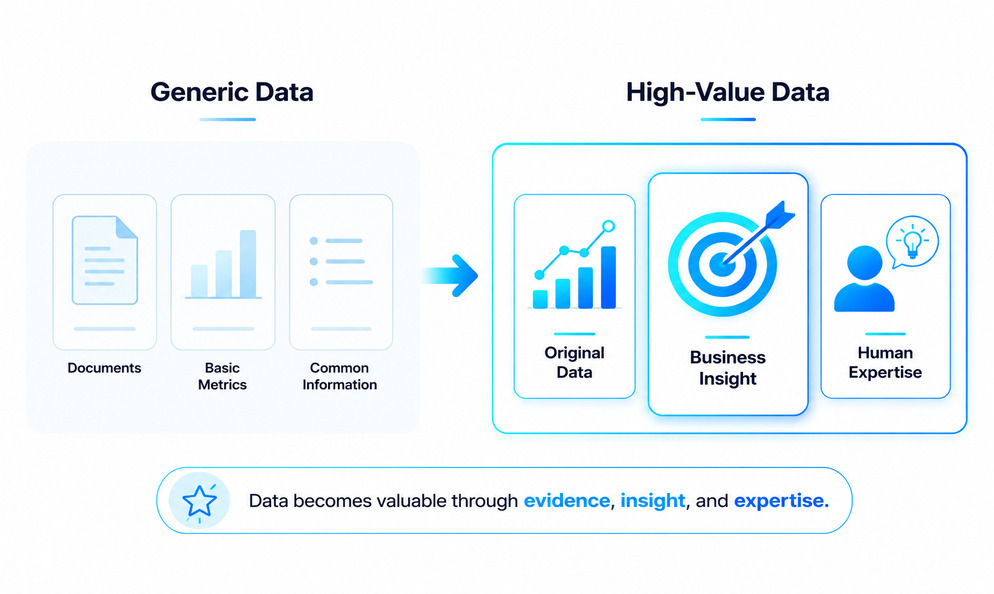
AI can summarize common knowledge. It cannot originate your experience.
4. Cover the Query Fan-Out, Not Just the Keyword
This is one of the biggest changes AI search introduces.
A single question can expand into multiple related searches, Ahrefs describes this shift as moving search from a one-query model toward one-to-many discovery.
Instead of planning content around: Primary keyword → article
think: Primary question → related questions → evidence → comparisons → decision
Google Search Console queries, People Also Ask, related searches, customer conversations, and AI Mode follow-ups can all help uncover those surrounding questions.
5. Connect Visibility to Revenue
Getting found is only the beginning. Similarweb found a brand recommendation from ChatGPT were 2.5× more likely to visit that brand's website within 7 days, also 55.9% of AI-influenced visits arrived through search.
Think of modern search performance as a progression: Found → Understood → Referenced → Remembered → Chosen
Technical SEO remains the foundation underneath all 5. Google still needs to crawl, index, and understand the page. But technical health alone does not create differentiation.
SEO, AEO, and GEO Are Becoming One Search Strategy
AI search brought us a lot of new terms like SEO, AEO, and GEO, but they all share the exact same foundation.
Google Says AEO And GEO Are ‘Still SEO’ also Ahrefs found searches for “generative engine optimization” increased 997% over 18 months.
The Surface Changes. The Foundation Overlaps.
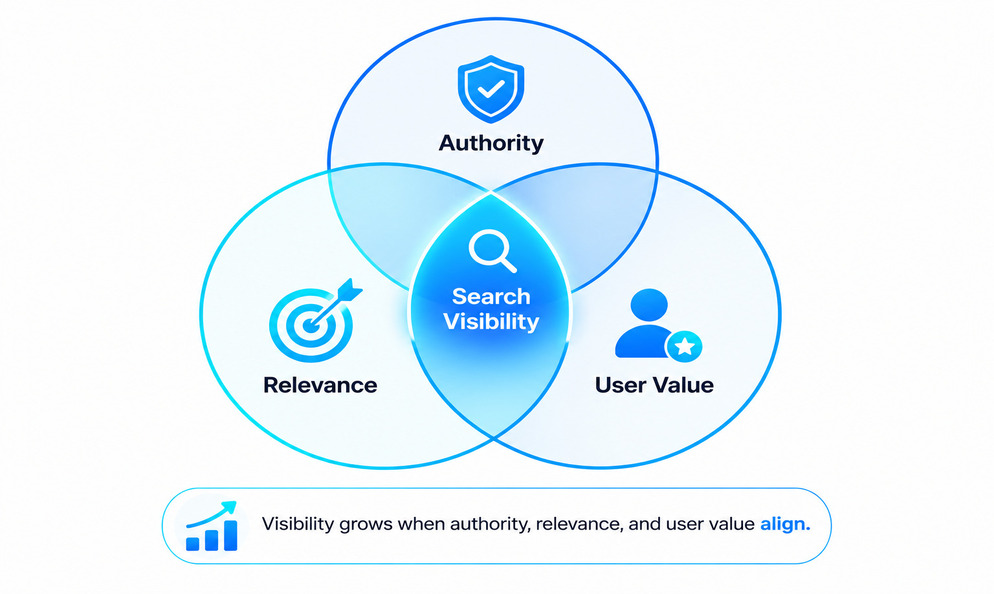 The easiest way to understand the difference is by looking at the outcome each discipline emphasizes:
|
Approach |
Primary Goal |
|
SEO |
Earn visibility and clicks in traditional search results |
|
AEO |
Make useful answers easy to identify and surface |
|
GEO |
Increase brand mentions, citations, and representation in generated answers |
The execution overlaps heavily. Strong search intent, useful content, technical accessibility, topical depth, original evidence, and authority still matter across all 3.
What changes is where the visibility appears and how you measure it.
How to Measure Search Performance Beyond Rankings
Rankings still matter. They just no longer show the entire search journey.
A page can rank well while competing with AI Overviews, appear as a source inside AI Mode, or influence a branded search that happens days later.
1. Keep the Core SEO Metrics
Continue tracking the fundamentals:
- organic impressions and clicks
- keyword positions
- organic conversions
- branded search demand
- traffic to commercial pages
Google is also expanding Search Console reporting for generative search experiences, making it easier to understand visibility from AI Overviews and AI Mode alongside traditional Search.
These metrics tell you whether your search footprint is growing.
2. Add AI Visibility Metrics
AI search changes how we measure success. Do not stress over a single screenshot or a one-time mention because AI answers change constantly.
Instead, track whether your brand appears consistently across these main metrics:
- AI Overview and AI Mode visibility
- Brand mentions
- Source citations
- Pages being referenced
- Visibility across important buyer questions
3. Connect Visibility to Business Value
Moving from position 5 to position 2 looks great on a report, but it means nothing if it does not bring you real business. Fewer direct clicks do not mean search is dead because AI often introduces buyers to your brand early in their journey.
If you want to track real value, ask yourself these basic questions:
- Are our branded searches going up?
- Are people visiting our case studies and service pages?
- Are those visitors actually turning into meetings and revenue?
Rankings only tell you where you appeared, but business outcomes tell you if appearing there actually mattered.
What Businesses Should Do in 2026
The practical response to AI search is not to abandon SEO or rebuild your content strategy around every new acronym.
Start with the areas that compound over time.
1. Build Around Decisions, Not Just Keywords
Prioritize searches that happen close to a business decision.
For a B2B company, that usually means topics around:
- Cost and pricing
- Comparisons
- Implementation
- Risks
- Timelines
- Alternatives
2. Publish Something Competitors Cannot Replicate
That could be first-hand experience, project data, an expert opinion, a comparison based on real delivery experience, or a framework developed from repeated client problems.
If the answer is “nothing,” the article probably needs more work.
3. Build Topic Coverage Around Buyer Questions
Do not obsess over creating one page for every keyword variation. Instead, identify the related questions a buyer asks before making a decision and connect them through a strong topic cluster.
Your main guide should answer the broad problem. Supporting articles can go deeper into cost, alternatives, mistakes, implementation, and comparisons. That creates a stronger search footprint than publishing isolated articles.
4. Make Proof Easy to Find
Claims are stronger when readers can verify them.
Use: Research → real experience → case study → clear next step
Common SEO Mistakes in the AI Search Era
The biggest mistakes in 2026 are not completely new. AI has simply made them more expensive.
1. Writing for Algorithms Instead of People
Adding short answer boxes, FAQ sections, or structured headings does not make weak content useful.
If the page does not solve the reader's problem, formatting will not rescue it.
2. Publishing Commodity Content
If an article simply combines the same information already available across ten other websites, both readers and AI systems have little reason to prefer it.
Add experience, evidence, or a point of view.
3. Measuring Success Only by Rankings
A ranking improvement matters when it creates meaningful visibility, demand, or revenue.
Position alone is not the business outcome.
4. Treating GEO as a Shortcut
There is no proven trick that guarantees an AI Overview citation or AI Mode mention.
Build the fundamentals first: useful content, authority, technical accessibility, strong topic coverage, and a recognizable brand.
Final Verdict: The New Reality of Search
Google rankings are not dead. But everything around those rankings has changed completely.
Before a user ever clicks a link to visit your website, they follow a messy path. They read an AI summary, chat with an AI assistant, watch a quick video, and check forum discussions. Only then do they look up your brand. Because of this, obsessing over an exact rank position is a trap. It is simply too narrow a view for the modern web.
The brands that win today are not the ones pumping out thousands of generic articles or chasing endless keywords. The winners are simply useful enough to find, trusted enough to believe, unique enough to remember, and relevant enough to choose.
Frequently Asked Questions
Yes.
AI Overviews and AI Mode change how Google presents information, but they still operate alongside Google's broader Search infrastructure and ranking systems.
The opportunity has expanded from simply ranking a page to being discoverable across traditional results, AI-generated answers, citations, and brand searches.

I work with founders and leadership teams when growth moves faster than their systems, teams, or decisions. I’ve led 850+ projects for 750+ clients across 20+ countries, working across 100+ technologies and counting. I care about ownership, clarity, and building things that last beyond the launch.
Featureblogs
Relatedblogs
Authorblogs
01
How to Choose an API Development Company for Your SaaS Product02
Why Software Companies Are Turning to Strategic Partnerships for Faster Growth03
Your SaaS Isn’t Slow Because of Developers It’s a Scaling Problem04
Why Some SaaS Companies Scale Faster Than Others05
AI vs Hiring: When Should SaaS Teams Automate Instead of Hiring?