Here’s where the shift happens.
The best CTOs don’t just scale teams.
They redesign how work happens.
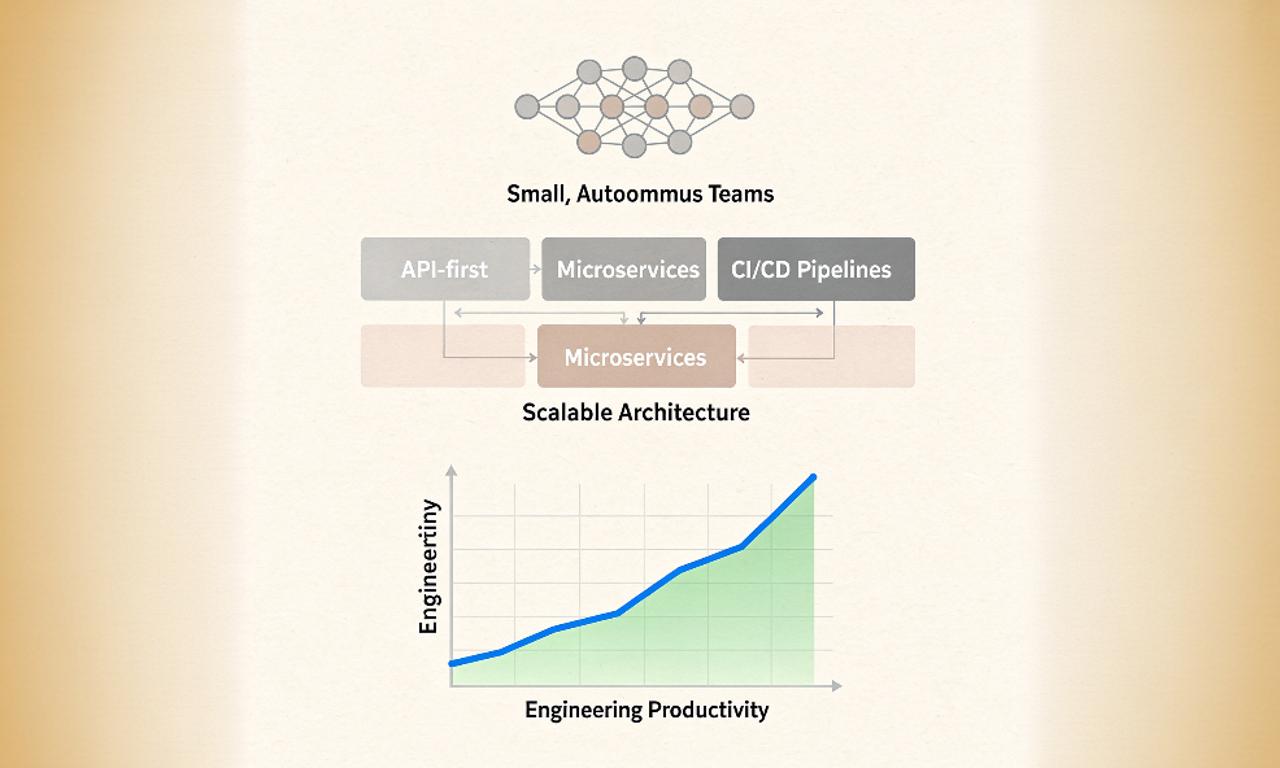
1. Build Small, Autonomous Teams
Instead of large departments, they build independent units.
Typical structure:
- Backend
- Frontend
- DevOps support
- Product owner
Each team owns a specific outcome.
No waiting. No cross-team dependency for every task.
Amazon’s rule is simple:
If a team is too big to be fed by two pizzas, it’s too big.
Small teams move faster because they:
- Communicate less
- Decide faster
- Own outcomes fully
2. Design Architecture for Independence
You can’t scale teams if your system forces them to depend on each other.
Modern teams prioritize:
- API-first design
- Modular systems or microservices
- Cloud-native infrastructure
- CI/CD pipelines
This allows multiple teams to work in parallel without blocking each other.
At Mediusware, we often see teams struggle not because of execution, but because early architecture decisions weren’t built for scale.
For example, platforms like CRM Runner show how modular architecture and automation enable smoother operations as teams grow.
3. Automate Everything That Slows You Down
Manual processes don’t scale.
They break under pressure.
High-performing teams automate:
- Testing
- Deployments
- Infrastructure
- Monitoring
According to DORA, strong CI/CD practices lead to 7× fewer deployment failures.
Automation doesn’t just improve speed.
It protects delivery.
4. Measure What Really Matters
If you can’t see bottlenecks, you can’t fix them.
That’s why great CTOs rely on DORA metrics:
- Deployment frequency
- Lead time for changes
- Mean time to recovery (MTTR)
- Change failure rate
These metrics give clarity.
And clarity reduces guesswork.
5. Build a Culture That Surfaces Problems Early
Technology scales systems.
Culture scales behavior.
Google’s Project Aristotle found:
Psychological safety is the #1 factor in high-performing teams.
When engineers can speak early:
- Problems don’t grow silently
- Risks are reduced
- Teams move faster with confidence