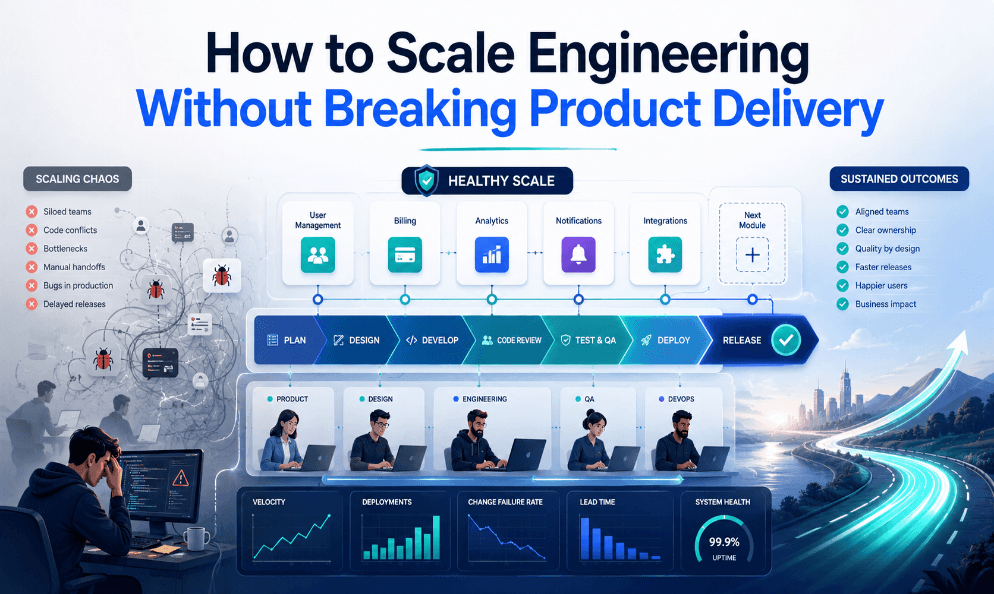
- Scaling engineering requires better systems, not just more developers.
- Clear ownership, QA, and delivery process protect SaaS product momentum.
How to Scale Engineering Without Breaking Product Delivery
Published on: 8 May 2026
Last updated on: 8 May 2026

Most SaaS companies do not break because they lack ideas.
They break because product demand grows faster than engineering delivery.
The roadmap gets bigger.
Customers ask for more.
Sales pushes for faster releases.
Investors expect momentum.
So the first reaction is simple:
Let’s hire more developers.
But adding more engineers does not automatically make product delivery faster.
Sometimes, it makes delivery slower.
Because scaling engineering is not just a hiring problem.
It is a system problem.
And if the system is weak, every new developer adds more meetings, more handoffs, more confusion, and more chances for delivery to break.
That is why SaaS teams need to scale engineering carefully.
Not just to write more code.
But to protect product momentum.
Why Engineering Scaling Breaks Product Delivery
When a product is small, delivery feels simple.
A few people understand the whole system.
Decisions happen quickly.
Developers talk directly with the founder or product manager.
Bugs are easier to trace.
But growth changes everything.
More customers create more edge cases.
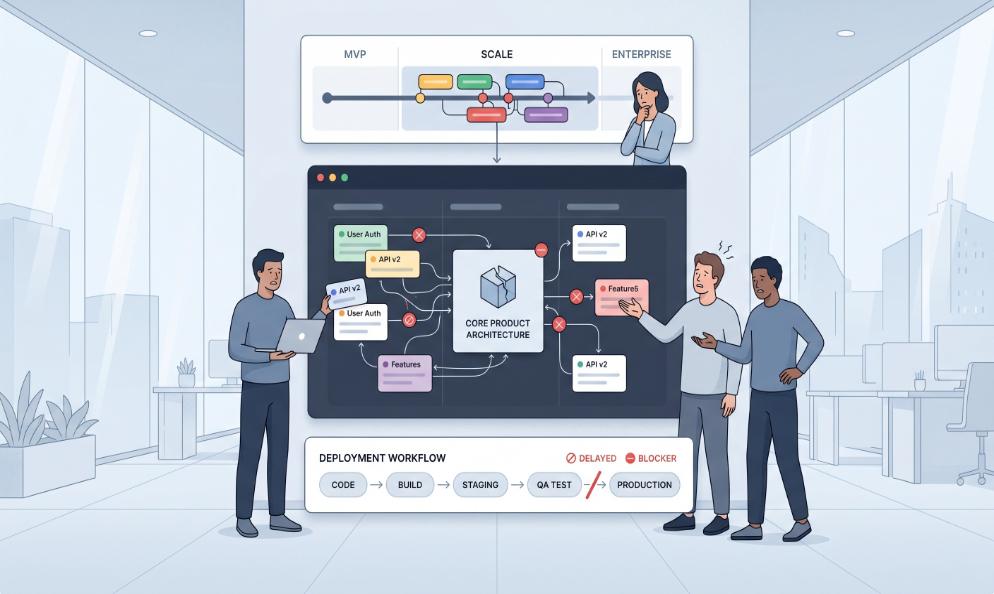
More features create more dependencies.
More developers create more coordination needs.
More releases create more QA pressure.
This is where many teams start feeling the gap.
They are working harder, but shipping slower.
That usually happens because the team scaled headcount before scaling the delivery process.
The First Mistake: Treating Engineering Capacity as a People Problem
More developers can help.
But only when the team has the right structure.
Without structure, more developers often create more complexity.
You may see problems like:
→ Two developers working on overlapping features
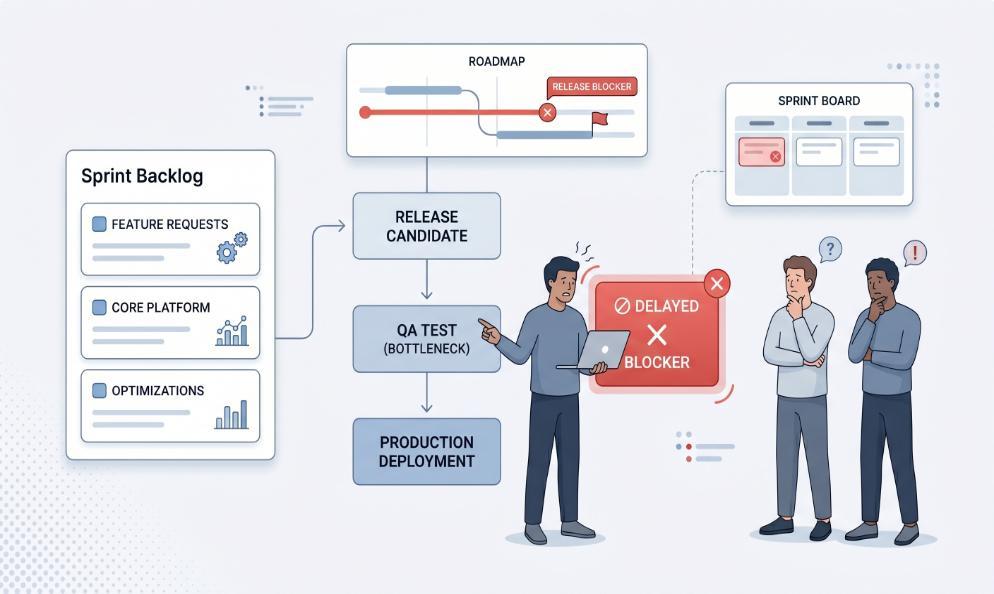
→ QA finding issues too late
→ Product requirements changing mid-sprint
→ Senior engineers becoming review bottlenecks
→ New hires waiting for context
→ Small changes creating unexpected bugs
→ Releases depending on one or two key people
This is why scaling engineering is not only about “more hands.”
It is about better ownership, better communication, and better delivery discipline.
A five-person team with clear ownership can often move faster than a fifteen-person team with unclear priorities.
The Real Cost of Poor Engineering Scaling
Broken delivery does not always look dramatic at first.
It starts quietly.
A release slips by one week.
Then another feature gets delayed.
Then QA starts finding more bugs.
Then support tickets increase.
Then the product team stops trusting estimates.
Over time, the cost becomes serious.
Poor engineering scaling can lead to:
→ Missed roadmap commitments
→ Slower customer feedback cycles
→ More production bugs
→ Burned-out developers
→ Higher management overhead
→ Lost trust between product and engineering
→ Delayed revenue opportunities
For SaaS companies, speed matters.
But predictable speed matters more.
A team that ships fast for two months and then collapses under rework is not scalable.
A scalable engineering team delivers consistently without destroying product quality.
What Actually Needs to Scale?
Before adding more engineers, leadership should ask a better question:
What part of our delivery system is not ready for growth?
Because engineering does not scale in one area only.
Several parts need to scale together.
1. Product Clarity
Developers cannot move fast when priorities change every few days.
If the product direction is unclear, engineering becomes reactive.
The team starts building based on urgency, not strategy.
Before scaling engineering, make sure the team knows:
→ What matters now
→ What can wait
→ What success looks like
→ Which features are business-critical
→ Which requests are distractions
A clear roadmap reduces unnecessary engineering effort.
It also helps developers make better technical decisions.
2. Technical Ownership
As teams grow, ownership becomes more important.
Without ownership, everyone contributes but no one is truly responsible.
That creates gaps.
A feature gets built, but no one owns long-term quality.
A module grows, but no one protects its architecture.
A bug appears, but the team spends hours figuring out who should fix it.
Every important part of the product should have clear technical ownership.
That does not mean one person does all the work.
It means someone is accountable for quality, decisions, and maintainability.
3. Communication Rhythm
Small teams can survive with informal communication.
Growing teams cannot.
When engineering scales, communication needs a rhythm.
Not more meetings.
Better meetings.
The team needs clear answers to questions like:
→ What is being built?
→ Why does it matter?
→ Who owns it?
→ What is blocked?
→ What changed?
→ What is ready for QA?
→ What is ready for release?
This reduces confusion and protects delivery speed.
The goal is not to make engineering bureaucratic.
The goal is to make execution visible.
Why Hiring Alone Does Not Fix Slow Delivery
Hiring feels like the obvious answer when the roadmap is delayed.
But hiring has hidden costs. New developers need onboarding.
They need product context.
They need codebase knowledge.
They need review support.
They need time before they become fully productive.
If your senior engineers are already overloaded, new hires may slow them down at first.
That does not mean hiring is wrong.
It means hiring without a delivery plan is risky.
A Better Framework for Scaling Engineering
Here is a simple way to think about it.
Identify the Real Bottleneck
Do not assume the bottleneck is always development.
Sometimes the real bottleneck is:
→ Unclear product scope
→ Slow design approval
→ Weak QA process
→ Poor sprint planning
→ Too much technical debt
→ Lack of senior engineering review
→ Unstable requirements
Adding developers to the wrong bottleneck does not solve the problem.
It only hides it for a while.
Final Takeaway: Scale the System Before You Scale the Team
Scaling engineering is not about hiring as many developers as possible.
It is about building a delivery system that can handle more people, more features, more users, and more business pressure.
If the system is weak, more developers create more chaos.
If the system is strong, more developers create more momentum.
So before you scale the team, ask:
→ Is our roadmap clear?
→ Is ownership defined?
→ Is QA strong enough?
→ Is architecture ready for growth?
→ Is communication clean?
→ Do we know where delivery is actually breaking?
Because product delivery does not break overnight.
It breaks when small gaps are ignored for too long.
And the best time to fix those gaps is before growth turns them into bottlenecks.