


- A strategic comparison of AWS, Azure, and GCP focused on team alignment, governance, cost control, and flexibility.
- An executive decision matrix to help leaders choose the cloud that fits their operating model and direction.
AWS vs. Azure vs. GCP: Your Executive Decision Matrix
Navigate
We are all familiar with those moments. You approved a cloud decision a few years ago. It felt safe. Everyone agreed. Now, AI workloads are growing fast, finance wants cost predictability, compliance is tighter, and your teams are feeling friction they can’t quite name.
You’re looking at the architecture and asking a quiet question: Did we really choose the right cloud?
This isn’t about missing features. All 3 hyperscalers can do the job. The difference is how much control you retain, how predictable your costs are, and how painful it would be to change direction if the business shifts. You and I both know the wrong cloud rarely fails loudly. It drains focus, budget, and trust over time. This executive decision matrix compares AWS, Azure, and GCP through the lens of fit, control, and long-term flexibility.
How Executives Should Evaluate Cloud Platforms
Cloud decisions today are no longer technical checklists. They’re operating model decisions. Think of it like choosing a city. Every city has power, roads, and internet. What changes your life is congestion, cost of living, and how easy it is to move when things don’t work out.
Cloud platforms behave the same way. So instead of asking what this cloud can do, executives should ask:
- How predictable is spending under pressure?
- How easy is governance without slowing teams?
- How reversible is this platform if priorities change?
That’s the frame for every section below.
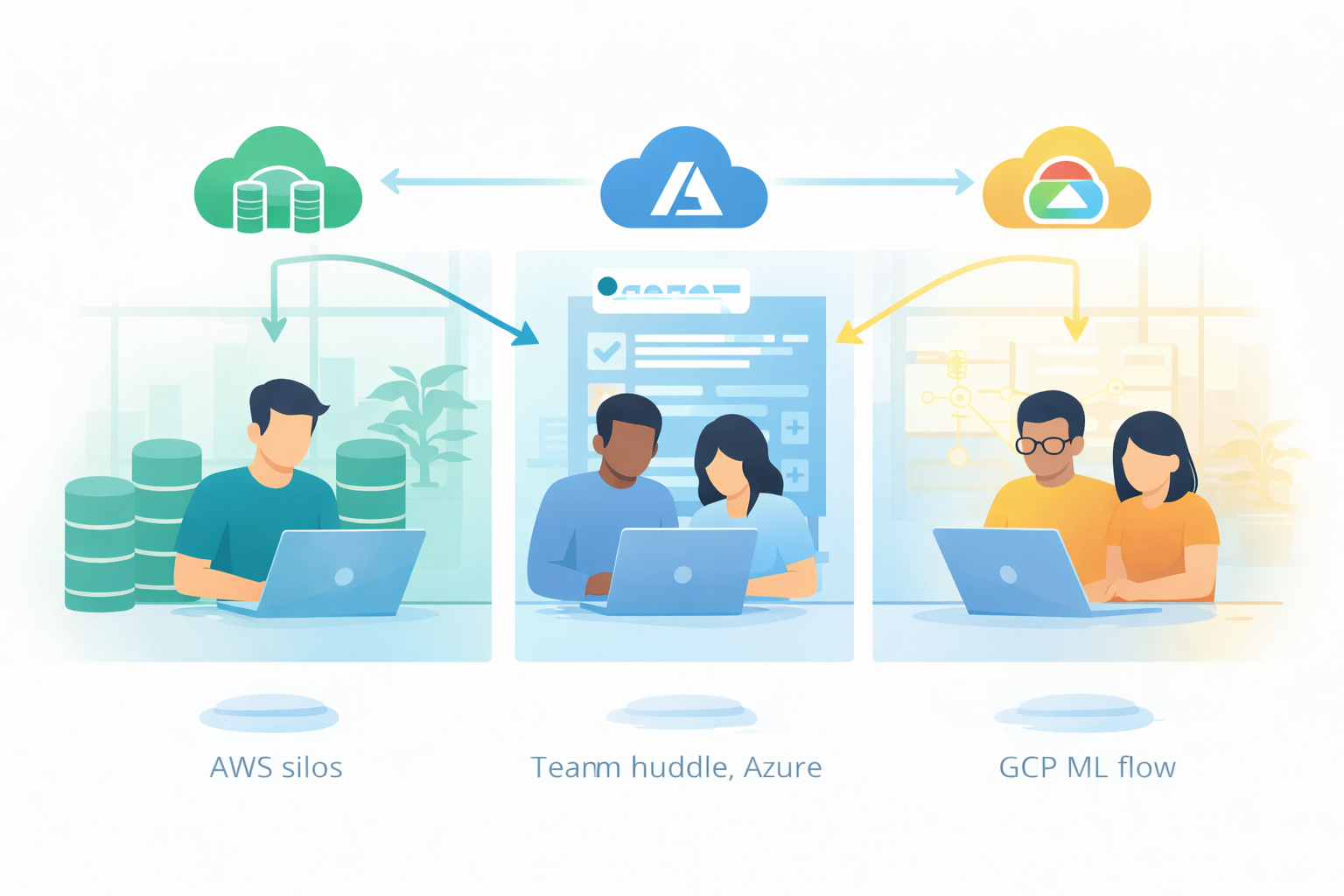
Engineering Alignment: How Your Teams Actually Work
Engineering alignment means how naturally a cloud supports your delivery model.
For Example, if teams ship independently, heavy centralized governance becomes friction. If you run a centralized platform team, too much freedom creates chaos.
Platform alignment in practice
|
Provider |
Engineering Model |
Best Fit |
|
Amazon Web Services |
Decentralized, service-owned |
Independent product teams |
|
Microsoft Azure |
Centralized, policy-driven |
Enterprise platforms |
|
Google Cloud Platform |
Data-first, automation-led |
Analytics & ML teams |
According to Conway’s Law, cited by Martin Fowler
Organizations design systems that mirror their communication structures.
Cloud platforms amplify how your teams already work. They don’t fix misalignment.
Security, Compliance, and Data Sovereignty
Security tooling looks similar across providers. Auditability does not. The real difference is how easily policy turns into evidence.
For Example, two companies are compliant on paper. One can produce audit trails in hours. The other needs weeks of manual reporting. Same regulation. Very different risk.
Governance behavior by cloud
- AWS emphasizes decentralized ownership with centralized guardrails
- Azure enforces tenant-wide identity and policy inheritance
- GCP focuses on zero-trust boundaries and data perimeters
Azure’s EU Data Boundary provides clear documentation for residency and processing. Also, AWS and GCP approach sovereignty differently, with more emphasis on architectural controls and isolation.
Choose based on how audits actually happen in your organization.
Cost Predictability and Financial Governance
Here’s the uncomfortable truth. Executives don’t lose sleep over compute prices. They lose sleep over variance they can’t explain.
For Example, AI usage spikes. The bill jumps. Engineering says demand grew. Finance asks why forecasts missed. No one has a clean answer.
Cost governance comparison
|
Cloud |
Cost Model |
Executive Impact |
|
AWS |
Flexible, granular |
Powerful but discipline-heavy |
|
Azure |
Governance-embedded |
Predictable, finance-aligned |
|
GCP |
Transparency-first |
Clear unit economics |
The FinOps Foundation reports organizations with strong cost allocation reduce waste by up to 30%. Cloud choice determines how hard that discipline is to enforce.
AI Infrastructure and Strategic Lock-In
AI has permanently changed cloud economics. The real question isn’t can this cloud run AI? It’s how locked in will we be when AI dominates spend?
- AWS pushes custom silicon for efficiency
- Azure prioritizes GPU availability and enterprise tooling
- GCP optimizes for large-scale training efficiency
McKinsey notes AI infrastructure decisions now shape cloud strategy more than traditional workloads. This is no longer a developer-only choice. It’s a long-term financial one.
Hybrid, Multicloud, and Reversibility
Reversibility doesn’t mean running three clouds at once. It means credible leverage.
For Example, if negotiations fail or regulations change, can you shift workloads without rewriting everything?
- AWS Outposts extends native services on-prem
- Azure Arc projects governance across clouds and data centers
- GCP Distributed Cloud standardizes Kubernetes everywhere
If your control plane is fragmented, your exit strategy is theoretical.
The Executive Decision Matrix
|
Priority |
AWS |
Azure |
GCP |
|
Team autonomy |
High |
Medium |
Medium |
|
Audit simplicity |
Medium |
High |
High |
|
Cost predictability |
Discipline-dependent |
High |
High |
|
AI flexibility |
High |
High |
Specialized |
|
Hybrid control |
Native |
Governance-first |
Kubernetes-first |
|
Reversibility |
Medium |
Medium |
High (cloud-native teams) |
There is no universal winner. There is only alignment.
Final Thought: Choose the Cloud That Fights You Least
AWS won’t fix broken delivery habits. Azure won’t untangle identity chaos by itself. GCP won’t clean up a messy data strategy. Cloud platforms magnify who you already are.
The smartest executives don’t ask which cloud is best? They ask which cloud lets us stay in control as we change? That’s the decision that holds up over time.
If you’re reassessing your cloud strategy, start with behavior, not services.
Use this matrix with engineering, finance, and security leaders. If you want help designing a reversible, cost-defensible cloud architecture, let’s talk. The earlier you design for control, the cheaper it is to keep it.

I work at the point where product decisions, system architecture, and engineering execution meet. At Mediusware, I’m accountable for how technology choices affect reliability, scale, and long-term delivery for our clients.