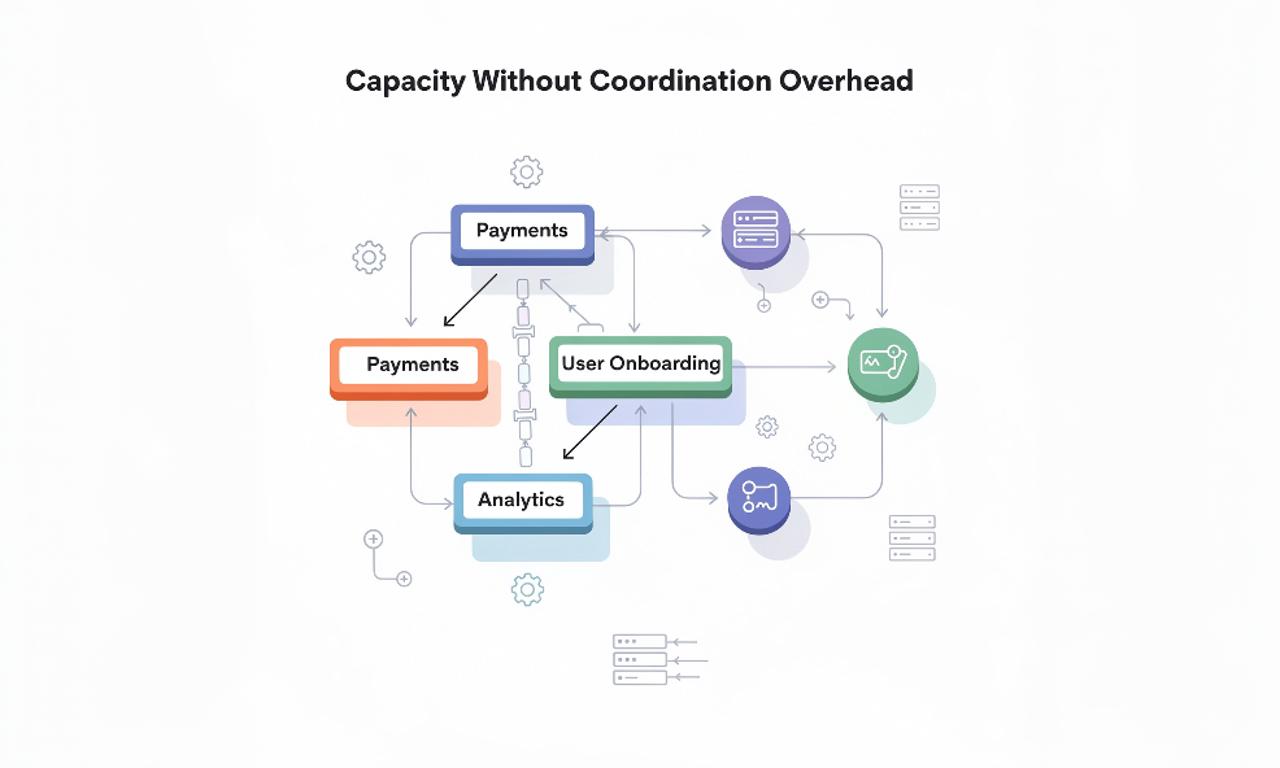
1. Build Small, Autonomous Pods
Instead of one large team of 15–20 developers, break it into:
- 3–5 person pods
- Each pod owns a feature or domain
Example:
- Pod A → Payments
- Pod B → User onboarding
- Pod C → Analytics
Each pod works independently, reducing coordination overhead. This structure is widely used by companies like Amazon's Two-Pizza Teams model.
2. Define Clear Ownership
One of the biggest sources of complexity is unclear ownership.
When multiple developers “share” responsibility:
- Decisions get delayed
- Bugs stay unresolved
- Accountability disappears
Instead:
- Assign one owner per feature/module
- Define clear boundaries
At Mediusware, we’ve seen platforms like CRM Runner improve efficiency by centralizing workflows and ownership into structured systems, reducing operational friction and decision delays .
Ownership removes confusion. Clarity reduces management load.
3. Invest in Scalable Architecture Early
You can’t scale teams if your system doesn’t scale.
Common mistakes:
- Monolithic codebase
- Tight coupling between modules
- No API boundaries
Better approach:
- Modular architecture
- Microservices (when needed)
- Clear API contracts
According to Google Cloud Architecture Framework, modular systems reduce team dependency and enable parallel development.
Good architecture = parallel execution = more capacity without more meetings.
4. Use Automation to Replace Coordination
More managers ≠ better delivery.
Instead, use:
- CI/CD pipelines
- Automated testing
- Deployment automation
- Monitoring systems
For example, platforms like Bulk.ly achieved up to 90% reduction in manual operational effort through automation, enabling teams to scale output without increasing management layers.
Automation replaces manual coordination. Less dependency on meetings and approvals.
5. Add Capacity Through Dedicated External Teams
Hiring internally is slow and increases management complexity.
A better alternative:
- Dedicated development teams
- Staff augmentation
- External engineering partners
But here’s the key: The external team must operate like an extension of your internal team, not a separate entity.
This model allows you to:
- Scale faster
- Maintain delivery speed
- Avoid internal overhead