-
Programming language choice shapes AI speed, cost, and scalability.
-
No single language fits every AI use case.
-
Strong AI systems often combine multiple languages.
-
Early language decisions prevent long-term technical debt.
Top Programming Languages for AI in 2025
Published on: 24 December 2025
Last updated on: 24 December 2025
Before you choose an AI model, before you hire data scientists, before you touch infrastructure, there’s a quieter decision that shapes everything.
Most teams rush past it.
They assume the programming language is just a tool. Something you can swap later if needed.
You can’t. At least, not without pain.
Choose well, and your AI system grows with you. Experiments stay cheap. Iteration feels natural. Scaling feels planned.
Choose poorly, and progress slows in ways that are hard to diagnose. Training takes longer. Features become harder to ship. Costs rise, and no one can quite explain why.
If you’re planning an AI project right now, ask yourself this.
Are you choosing a language because it fits your problem, or because it feels familiar?
In this guide, we’ll break down the top programming languages for AI and look at what really matters.
Not popularity. Not hype. But how each choice plays out once your AI moves beyond demos and into real use.
Why programming language choice matters in AI
Most AI projects don’t fail loudly.
They don’t crash on day one. They don’t throw obvious errors. They start strong, then slow down. Iterations take longer. Fixes feel harder than they should. Teams begin working around problems instead of solving them.
That’s usually when people blame the model. Or the data.
But here’s what actually happens.
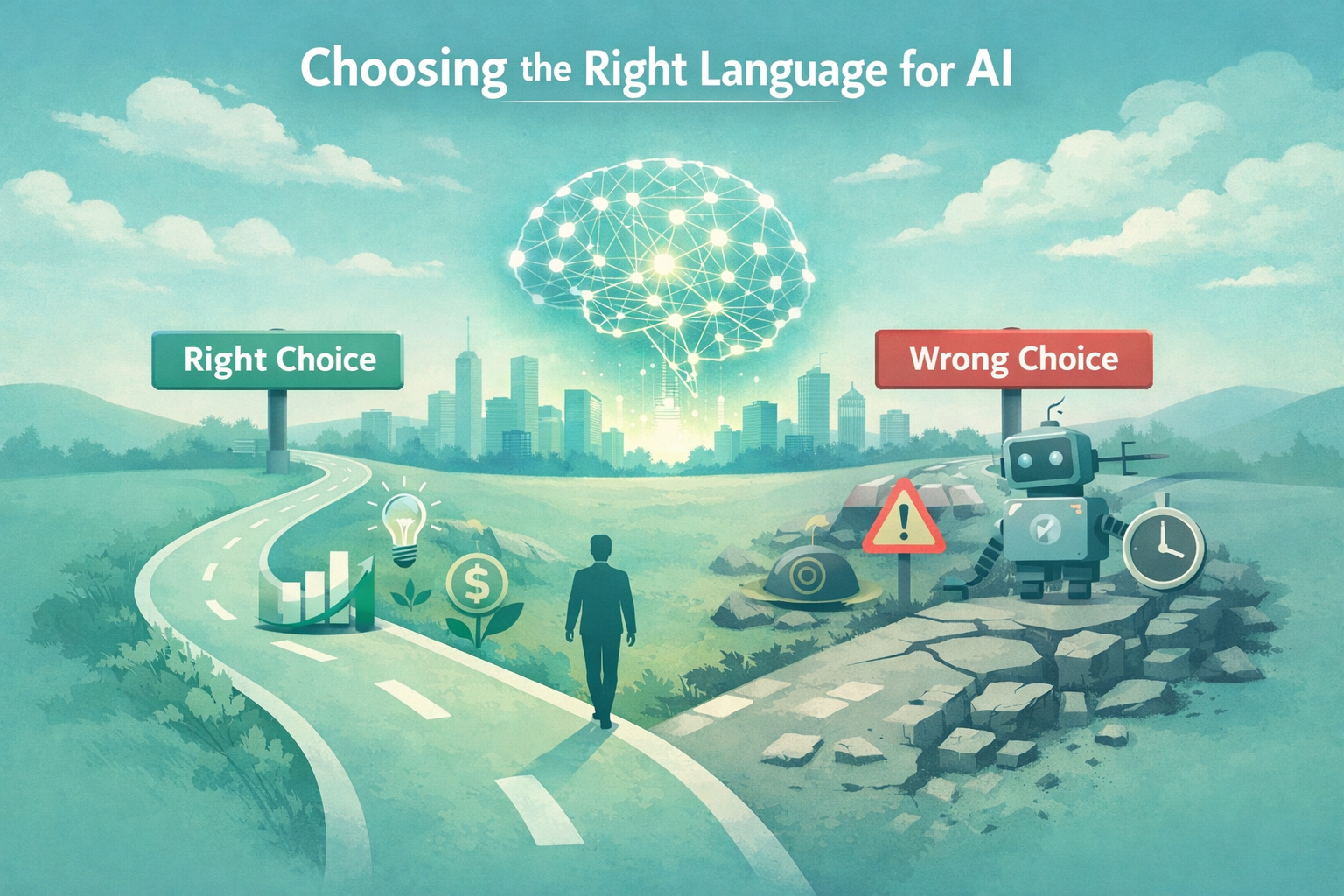
The programming language you choose shapes how your AI system grows. It affects how fast you can experiment, how easily you can fix mistakes, and how painful scaling becomes later.
Think about it this way.
You’re not just choosing a language for today’s version of the product. You’re choosing how your team will live with this system for the next two or three years.
A simple example
Imagine two teams building the same AI-powered recommendation feature.
Both start small. Both launch successfully.
One team chose a language that makes experimentation easy. Adding features feels natural. Debugging is manageable. Hiring is not a problem.
The other team chose a language that looked powerful on paper. Six months later, small changes take weeks. Performance tuning requires specialists. New hires struggle to onboard.
Same idea. Same model. Very different outcomes.
That difference usually comes down to language fit, not intelligence or effort.
Where most teams go wrong
Most teams choose a language based on one of these reasons:
- It’s what the team already knows
- It’s popular right now
- It worked for a previous project
- It sounds powerful
Those reasons feel safe. They rarely are.
AI systems change faster than traditional software. The language that feels comfortable today may become restrictive once data grows, real users arrive, and performance expectations rise.
Choosing well means thinking beyond comfort and asking tougher questions early.

Python and AI development
If you ask ten AI teams what language they started with, most will give the same answer.
Python.
Not because it is the fastest.
Not because it is the most powerful.
But because it removes friction at the exact moment teams need speed.
Why Python became the default for AI
Python makes it easy to turn ideas into working models.
Its syntax is simple. The learning curve is gentle. And the AI ecosystem around it is mature. Libraries like TensorFlow, PyTorch, and scikit-learn let teams focus on logic instead of building everything from scratch.
A relatable example
Imagine you are building an AI-powered product recommendation system for an e-commerce site.
With Python, you can:
- Load data quickly
- Test multiple models in days
- Compare results without rewriting large chunks of code
This speed is why Python dominates early-stage AI work.
Where Python really shines
Python works best when:
- You are experimenting
- You are still validating ideas
- You need fast iteration
- Your models change often
That is why startups, research teams, and product teams love it. Python helps you move forward without overthinking infrastructure.
The tradeoff most teams discover later
Python is not built for everything.
As data grows and systems move closer to real-time use, Python starts showing its limits. Execution slows. Memory usage increases. Latency becomes noticeable.
This is where many teams hit a wall.
They try to force Python to handle performance-heavy tasks. It works for a while. Then costs rise and complexity creeps in.
A practical way teams handle this
Strong teams do not abandon Python.
They pair it with other languages.
Python handles:
- Model training
- Experimentation
- Data processing
Languages like C++ or Java handle:
- Performance-critical components
- Real-time execution
- System-level integration
This hybrid approach is common in production-grade AI systems.
When Python is the right choice
Python is a strong fit if:
- You are building an MVP
- You need fast learning cycles
- Your AI system is still evolving
- Your team values flexibility over raw speed
If your system must make split-second decisions or run at massive scale, Python alone may not be enough.
But as a starting point, few languages match its balance of simplicity and power.
Java in enterprise AI systems
Python often wins at the starting line.
Java usually wins the marathon.
If your AI system is expected to live inside a large product, handle steady traffic, and run for years without surprises, Java starts to make a lot of sense.
Why enterprises still rely on Java for AI
Java is built for stability.
It runs on the JVM, which has been battle-tested for decades. Memory management is predictable. Performance is consistent. Monitoring and debugging tools are mature.
A simple example
Imagine an AI system that monitors thousands of financial transactions every second to detect fraud.
This system:
- Cannot crash
- Cannot slow down unpredictably
- Must integrate with existing backend services
Java fits naturally in this environment.
Where Java shines in AI projects
Java works well when:
- AI models must run continuously
- Systems need strong reliability
- Integration with enterprise platforms matters
- Long-term maintenance is a priority
Frameworks like Deeplearning4j and Apache Spark’s ML tools support large-scale data processing and model deployment.
The cost of choosing Java
Java is not friendly to rapid experimentation.
Writing AI code in Java takes more time. The syntax is verbose. Trying new ideas feels slower compared to Python.
For teams still exploring what they should build, this friction can hurt progress.
A common real-world pattern
Many mature teams use:
- Python for research and experimentation
- Java for deployment and infrastructure
This split allows teams to move fast early and stay stable later.
When Java is the right choice
Java is a strong option if:
- You are building AI inside an existing enterprise system
- Stability matters more than speed of experimentation
- You expect long-term growth and maintenance
If you are still searching for product-market fit, Java may slow you down. But once the direction is clear, it can carry AI systems far without breaking.
C++ for performance-critical AI
C++ exists for one reason. Control.
It gives engineers direct access to memory, hardware, and execution flow. That level of control matters when AI systems must react instantly and consistently.
A relatable example
Think about an autonomous driving system.
The AI cannot pause.
It cannot hesitate.
It must process sensor data and make decisions in milliseconds.
In these cases, Python is too slow. Java adds overhead. C++ does not.
Where C++ truly shines
C++ is a strong fit when:
- Decisions must happen in real time
- Latency directly affects outcomes
- Hardware resources are limited
- Every millisecond counts
That’s why you see C++ in robotics, gaming AI, real-time computer vision, and high-frequency trading systems.
The hidden cost of C++
C++ demands discipline.
Development takes longer. Debugging is harder. Small mistakes can create serious problems. Hiring experienced C++ engineers is also more challenging.
This is not a language most teams should start with.
How teams use C++ wisely
In practice, strong teams isolate C++ to where it matters most.
C++ handles:
- Inference engines
- Real-time decision loops
- Performance-critical paths
Other languages handle:
- Model training
- Data pipelines
- Business logic
This keeps systems fast without making everything complex.
When C++ is the right choice
C++ makes sense if:
- Performance is non-negotiable
- AI interacts directly with hardware
- Delays could cause failure, not inconvenience
If speed is not your main constraint, C++ may slow your team more than it helps.
R for data-driven and statistical AI work
R often enters AI conversations quietly.
It’s not flashy. It’s not used for large production systems. But when the problem is deeply tied to data and statistics, R feels natural.
Where R fits in AI
R is strongest when AI is about understanding data, not serving millions of users.
It shines in:
- Statistical modeling
- Forecasting
- Risk analysis
- Pattern discovery
A relatable example
Imagine a team analyzing customer churn.
They want to:
- Study historical behavior
- Test different statistical assumptions
- Visualize patterns clearly for stakeholders
R makes this kind of work straightforward. Its built-in tools and visualization libraries help teams see what the data is really saying.
Why teams still use R
R makes complex statistical ideas easier to explore.
You can test models, adjust assumptions, and visualize results quickly. For data scientists focused on insight rather than infrastructure, this matters a lot.
Where R starts to struggle
R is not designed for production-scale AI.
As datasets grow, performance slows. Memory usage increases. Real-time processing becomes difficult.
That’s why R rarely runs customer-facing AI systems.
When R is the right choice
R works best if:
- Your AI work is research-heavy
- You need strong statistical analysis
- Results are shared as insights, not real-time decisions
If your AI system must scale or respond instantly, R is usually not the right tool.
Julia for scientific and high-performance AI
Julia sits in an interesting middle ground.
It aims to combine Python’s readability with C++-level speed.
Why Julia is gaining attention
Julia was built for numerical and scientific computing from day one.
It performs well with:
- Large simulations
- Mathematical models
- Optimization-heavy workloads
A simple example
Consider a climate modeling system.
The AI must process massive datasets, run simulations repeatedly, and adjust variables quickly. Python becomes slow. C++ becomes hard to manage.
Julia offers a cleaner balance.
Where Julia excels
Julia is a strong fit when:
- Performance matters
- Code readability still matters
- Workloads are math-heavy
- Parallel processing is needed
Its native support for parallel computing helps teams scale calculations efficiently.
The tradeoff teams should know
Julia’s ecosystem is still growing.
There are fewer libraries. Fewer experienced developers. Onboarding takes time.
For teams used to Python’s rich ecosystem, this can feel limiting.
When Julia makes sense
Julia is a good choice if:
- You work in scientific or research-heavy AI
- Performance limits are already a problem
Your team is comfortable with mathematical thinking
For rapid product development, Julia may slow you down. For scientific precision, it can be a powerful option.
Less common AI languages and where they fit
Some languages appear niche but solve very specific problems.
- Haskell supports mathematically rigorous systems where correctness is critical.
- Prolog handles symbolic reasoning and rule-based AI.
- Scala works well with Apache Spark for large-scale data-driven AI pipelines.
These languages are rarely first choices. They become valuable when your problem strongly matches their strengths.
Programming languages not suitable for AI
Some languages struggle with AI workloads.
PHP, Ruby, and Visual Basic lack the numerical computing depth AI requires.
Swift and Objective-C work well for Apple platforms but fall behind in AI tooling.
That does not mean they are bad languages.
They are just not built for AI-first systems.
How to choose the right programming language for AI
This is where most teams overcomplicate things.
There is no perfect language.
There is only a good fit.
Instead of asking what is the best language for AI, ask these questions.
1. What does your AI system actually need to do?
Is it:
- Experiment-heavy?
- Real-time?
- Data-intensive?
- Research-focused?
The answer immediately narrows your options.
2. How fast do you need to move?
If you need rapid iteration, Python makes sense.
If stability matters more than speed, Java fits better.
3. What does scaling look like for you?
Some systems scale in users.
Others scale in data.
Some scale in complexity.
Different scaling paths demand different languages.
4. What does your team already know?
A technically perfect choice that your team cannot maintain will fail.
Language choice must align with people, not just architecture.
Quick comparison table
|
Use Case |
Best Fit |
|
Rapid prototyping |
Python |
|
Enterprise systems |
Java |
|
Real-time performance |
C++ |
|
Statistical modeling |
R |
|
Scientific computing |
Julia |
|
Big data AI pipelines |
Scala |
|
Rule-based reasoning |
Prolog |
|
Safety-critical logic |
Haskell |
This table is not a rulebook.
It is a starting point.

The future of AI development languages
In 2025, most serious AI systems are multilingual.
Python for models.
C++ for performance.
Java or Scala for infrastructure.
The future is not about choosing one language forever.
It is about choosing wisely, early, and planning for evolution.

Final thoughts
AI success is rarely blocked by ideas.
It is blocked by decisions made too casually at the beginning.
Programming language choice may feel small, but it quietly shapes how fast you move, how much you spend, and how long your system survives.
If you are building or scaling an AI product and want guidance grounded in real-world delivery, Mediusware can help you think through architecture, language choices, and long-term scalability with clarity.
You do not need more tools.
You need better decisions.
Need help making the right AI decisions?
Explore our AI services; we help teams plan, build, and scale AI systems with the right architecture, language choices, and long-term clarity.

I work at the point where product decisions, system architecture, and engineering execution meet. At Mediusware, I’m accountable for how technology choices affect reliability, scale, and long-term delivery for our clients.
Featureblogs
Relatedblogs
Authorblogs
01Why Lean Engineering Teams Are Replacing Large Development Departments02How Artificial Intelligence is Transforming Investment Strategies in 202603Quit Guessing the Price: Use This 2026 AI Cost Calculator Framework04Decoding the Neural Spec: Why Prompt Engineering is the New Norm in Software Development05The Ultimate Guide to Generative AI Strategy: Frameworks and ROI Metrics